
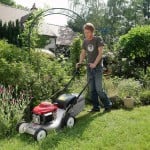
Once you have established your lawn, there are many things which need to be done in order to regularly maintain its health and appearance.
The attention that your lawn needs will vary depending on its size and type, as well as the site and climate. Usually, mowing and watering are the most frequent tasks which need to be performed for great maintenance. However fertilising, aerating, top-dressing, and moss and weed control are included for annual maintenance.
Mowing

Not only will mowing your lawn make the grass a delight to walk on, but regular mowing helps to create a dense, healthy sward with an even attractive finish.
Mowing is needed most frequently in warm, moist conditions such as early and late summer, however if there is a drought occurring, it is best to either not mow at all, or set the lawnmower to a higher cut.
During very wet, or frosty weather, it’s important to delay mowing because wet grass will clog up your mower. Wet grass could also encourage the mower to slip when in use, which is a serious safety hazard.
If you are mowing a very fine lawn, then brushing with a besom beforehand raises the grass to achieve a much better cut. Brushing your lawn every morning also helps to remove dew and dries the grass surface making it much easier to mow.
Lawn Mowers
For many lawns, a cylinder or rotary mower is suitable to use. If you opt for a roller mower, then it will provide your lawn with the finest finish thanks to the desirable stripes that it leaves. A lawnmower with no roller will leave a perfectly neat, maintained finish for a domestic lawn. With a mulching mower, the clippings are used as a fertiliser to naturally nourish the grass without any chemicals. The type of mower you choose should depend on the size of your garden and the type of finish that you require.
Frequency and Height of Cut
Both the frequency of mowing and the height of cut depend on a number of things including type of grass, how the lawn is used, and the time of year. However, as a general rule follow the phrase, ‘ little and often’. You should try to not remove more than a third of growth at any one time, so that it doesn’t become distressed and can then recover once again after each mow.
Frequent mowing is very necessary in the summer when the grass starts to grow quickly, but in spring and autumn the rate should be reduced, and in winter, only occasional removal of the grass tips can be necessary.
If the grass you are cutting is a very high quality (such as parks and greens), it can be cut as low as 0.5 cm, but they must be mown very frequently (every 2 or 3 days in summer) to maintain a fresh, healthy appearance. Domestic lawns should be left to grow slightly longer as these grasses will not tolerate such low cuts. The longer grasses will also protect the surface against any heavy wear.
You don’t have to mow all areas of your garden the same height. For example, try two or three different heights of cut in different areas to add texture and interest to the garden. It is recommended to cut the main area (used for walking or playing) to roughly 1 – 2.5 cm to protect the roots of grass from any wear and tear. Mow areas under trees much less frequently, perhaps every one or two weeks in summer to a height of 5-10 cm. Any areas of flower-rich grassland should be left at roughly 10 cm and do not need more than 3 cuts per year. They also should not be cut until the flowering species have shed their seed around mid-summer. Due to these areas being mown less frequently, they will produce ore debris which should be raked and removed after every mow.
Creating Stripes
If you have a mower fitted with a roller, then you have all you need to achieve that classic striped effect that is often desired.
If you have a ‘regular’ rectangular shaped lawn, then first mow a wide strip at either end of the lawn, and then mow up and down in straight lines, slightly over-lapping the previous strip to ensure that all the grass is mown.
If you have an irregular shaped lawn, then begin by mowing all around the edges. Then by starting at the centre of one end, mow a straight line down the middle right down the middle. Then mow straight strips up and down one half of the lawn, then return to the centre and mow the other half in the same way.
Mowing Sports Lawns
For areas which are often used for ball games, such as bowls, putting or croquet, vary the direction in which you are cutting to avoid a “grain” from developing. This is produced when the grass can only grow in one direction and not only affects the way it will grow, but also the run of the ball.
Grass Clippings
If you opt to discharge your clippings as opposed to collect them or mulch them, then it can be very important to remove them afterwards in order to discourage earth worms and lessen the spread of annual meadow weeds such as speedwell. By removing any clippings from your lawn it will prevent a build up of thatch and then maintain a finer, healthy maintained finish.
Taking care of your lawn is vital in order to avoid any unwanted weeds and damage to the grass. Stick to a regular mowing pattern so that it stays fresh, healthy, appealing and well maintained.
To browse our selection of lawnmowers which would work wonders with all different types of lawn, then click here.
Don’t forget, when it comes to purchasing from the Just Lawnmowers website, to receive a £5 discount all you have to do is ‘like’ our facebook page.
If you’re uncertain about anything, or would like further details, then call our highly experienced sales team now on 01263 820202 for helpful, friendly advice.


amazing tips Alex, will definitely keep in my mind next time mowing.