
Most lawn problems can be solved by the selection of the right grass seed, regular mowing, fertilisation, watering and scarifying. Today we go over some of the most common problems you may encounter with your lawn.
 Weeds
Weeds
Weeds may impair the appearance and use of your lawn. Common weeds include thistle and dandelion. As they are unable to withstand frequent mowing, this is one way of reducing them. The most environmentally friendly form of weed removal is by digging them out. If the lawn has bare patches, weeds are likely to take root, so resow these regularly. In contrast, weeds do not stand much chance on a healthy, well-cared for lawn.
Weeding tips
- Use a hoe only on sunny days when the soil is dry. Otherwise some disturbed weedlings may irritatingly re-root and go on growing.
- Fine-rooted weeds often snap off in your hand. To ease out the entire plant, grab the top growth with one hand and prise up the roots with a fork.
- Don’t compost annual weeds. Some (such as chickweed and hairy bittercress) already carry ripening seeds.
- If you let your weeds go to seed one year, you will be weeding for the next seven. That’s how long the seeds can linger. Make sure you never let them go to seed!
 Moss
Moss
Moss does not drive out the grass, but establishes itself when grass no longer grows. Moss herbicide is therefore not a solution. Moss benefits from lawns that are cut too short and by weakened grass. Improvements can be made by raising the cutting height and through good fertilisation. If you have a lot of moss and it look like it is taking hold of your lawn, then you must take a more long terms approach. This long term approach includes a schedule of targeted fertilisation including soil improvement and resowing with a good grass seed mixture. The soil under a moss-infested area if often too acidic (arising from water-logged soil, with an absence of air). Good drainage is necessary as just spreading lime will not remove the moss.
Moss removal (information originally supplied by the Royal Horticultural Soceity)
Remove loose moss in autumn, by scarification (vigorous raking). On small lawns this can be done by hand, raking out the moss with a spring-tine rake, but on larger lawns mechanical scarifiers can be used.
For moss control use a proprietary product, such as those based on ferrous sulphate (sulphate of iron) in spring or early autumn. When the moss blackens after two or three weeks use a spring-tine rake to remove it. The dead moss can be added to the compost heap. The ready-to-use formulations of ferrous sulphate can be used to spot treat small patches of moss on lawns.
Mosskillers combined with a fertiliser (nitrogen, phosphorus or potassium, indicated by the abbreviations NPK) are beneficial where grass vigour is low.
Apply mosskillers either by hand or with a push-along spreader. Be careful not to apply lawn sand (ferrous sulphate mixed with a carrier) at too high a rate as this can blacken and kill the grass as well as the moss. Apply lawn mosskillers in fine weather. Some require watering after 48 hours if there has been no rain. Check pack for details.
Control with a mosskiller will only be temporary unless the conditions which allowed the moss to become established are improved.
Patio Magic (containing benzalkonium chloride) will control moss on artificial turf. Keep artificial turf in good condition by regular brushing. Ensure water is not allowed to pool on the surface.
Fungal diseases
There are many fungi that can infect the lawn, but only a few are really damaging (an example being snow mould). This mould develops while the lawn is covered in snow and little air is able to circulate, letting the disease thrive. Fungi spread is due to some of these conditions being present:
- Very dense grass
- Thick lawn thatch
- High humidity
- Too low or too high pH values
- Over fertilisation
- Leaf/litter covering
- Snow covering in winter
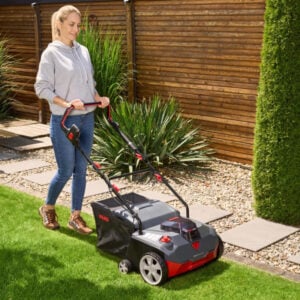
Fungus can usually be stopped in its tracks with a fungicide treatment and lawn aeration, which allows the soil to breathe. Aerating the lawn (or scarifying) is the process of removing dead material or thatch using a lawn scarifier , which also aerates and loosens up the turf. Scarifying is the vertical cutting or scoring of soil and grass roots, which ensures improved aeration of the soil, with lawn thatch and weeds being removed. A lawn which is scarified once or twice a year shows improved growth, is healthier and has a more attractive appearance.