
Hand-sharpening your chainsaw chain can be a bit of a daunting task for the first time, it is essential that you follow this guide to ensure that you sharpen it correctly. A sharp chain is definitely essential for an efficient working saw.
 Chainsaw Chain Sharpening
These 13 steps will guide you through the process of chain sharpening:
- The first step would be to examine the size or gauge of your saw’s chain. If you keep the packaging when you purchase a new chain this will be the easiest step. You will need to buy a chainsaw file that matches the chain type. There are several sizes of chainsaw teeth, the file you choose must be the correct diameter for your saw. Many manufacturers sell filing kits and it pays to purchase one with your saw. If you are still in doubt, take your saw to your nearest garden machinery store and they should be able to match a filing kit for you.
- Be sure to clean the chain thoroughly. Using mineral spirits or a degreasing fluid to remove oil, dirt, and debris from your chain would be recommended. Take care to not get excessive cleaner on the engine or other components, since some of these products can cause irreparable damage the plastic housing and other parts.
- Next inspect the chain for any damage or over-worn links and teeth. Individual teeth may have become chipped, broken, or bent; these can become very dangerous during use. Any damaged, weakened, or over worn chains should be discarded.
- You should set your saw on a solid surface or ideally clamp the bar in a vice. The saw must be stable to file your saw safely and accurately. Clamping the bar in a vice(but not too tight, you do not want to damage it), with the jaws holding the bar and allowing the chain to rotate freely.
- Locate the shortest cutter on the chain. If all of the cutters seem to be the same length, you may start anywhere. The reason behind this is that you need to file each cutter so that the flat on top of the cutter is nearly the same length. This ensures that each cutter cuts away the same amount of wood as the saw cuts. It also may help to mark the first tooth you file with a dab of tip-ex or a permanent marker as a reference.
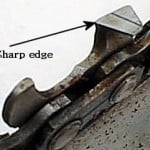 Set your file in the notch on the front of the cutter. This is the angled tooth in front of the flat surface of the chain link. The curvature of the file should fit in the curve of the face of the cutting tip, and the top of the file should be nearly flush with the top of the tooth.
- Set your file at the same angle (almost diagonally across the bar) as the front edge of the blade. Essentially you should hold the file at the same angle that the cutter is ground or filed to begin with. It is essential to match the angle the chain is originally machined to. Some saw teeth have witness markers as a visual aid.
- We can now start sharpening. Slide the file across the face of the cutter, using a twisting motion to discard filings that are removed. The best direction for pushing the file is still debated, but usually you will push the file from the short side of the angle toward the long point. This should leave a smoother cutting surface.
- Be consistent now. Work each and every tooth on the chain in the same manner. You will want to spin the chain around the bar so the teeth you are filing are always on the top.
- Now change sides of the saw, and proceed around the unfiled teeth angled in the other direction. Keep an eye on the length of each flat top on the cutter. If you wish to be 100% accurate, you may measure each tooth with callipers for the best cutting performance.
- If you purchased a sharpening kit, there should be a tool included to check the clearance of the curved hook-shaped links between the cutters. This tool is laid on top of the blade. If the gauge is too high, and must be filed, this tool protects the adjacent tooth as you file the gauge down. They should clear each cutting edge about 2.5mm lower than the cutter. This gauges the amount of chip that the cutter removes on each pass through the wood.
 File any depth gauges that are too high with a flat file.
- Oil your chain heavily. Tighten your chain if necessary. Turn your saw’s tension-adjustment screw until the bottoms of the lowest tie straps and cutters come up and contact the bottom of the bar rails. Chain tension on a solid-nose bar should be adjusted looser than on sprocket nose bars. Regardless of your bar type, your chain should move freely around the bar.
For a visual aid on chainsaw chain sharpening, please refer to Stihl’s video:
If you are in the market for a new chainsaw, then talk to one of our experts on 01263 820202, or visit our chainsaw pages at ://www.justlawnmowers.co.uk/chainsaws.htm


Thanks for the detailed step-by-step guide! Will become very useful one day.