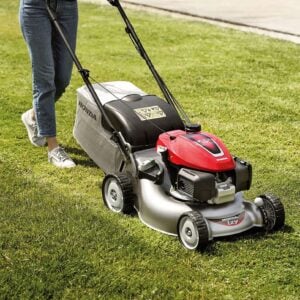


Mowing the lawn
Regular mowing makes a lawn dense and attractive. The cutting of grass stimulates the grass plant to form new side-shoots, leaf blades and runners, and weeds are effectively suppressed. The optimum cutting height is between 3.5 and 5cm so you should never aim to cut lower (in the shade). If the grass is cut shorter than the tolerance level of the grass, then the lawn will inevitably “thin out”. If the grass is very long a good idea would be to mow in several stages, never in a single cut. Depending on where you live, lawn characteristics, weathering etc, the lawn must be mown on average 20-25 times during its growing period mid April to late October, ie approximately once a week (depending on growth). Regular sharpening of the blades also ensures a better cutting pattern and makes the job easier.
Preparing to Mow
Before you mow, pick up objects lying on the lawn. Toys, tools, tires, car parts, cans, bottles, stones, sticks, twigs, and limbs are hazards to children playing on the lawn even when a mower is not operating. These items also present great danger to the operator, bystanders, and the mower when mowing begins.
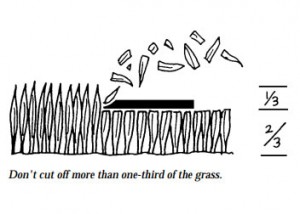 The one-third rule of mowing
Along with mowing at the correct height, mowing with adequate frequency is crucial to producing a high quality, attractive lawn. The “one-third rule” is a guideline for deciding when to mow. Very simply, this rule says to never remove more than one-third of the canopy height at any one mowing. Failing to follow the one-third rule results in the removal of excessive leaf tissue, shocking the grass. The result will be a thin, stemmy turf with a poor root system. Further, mowing excessively tall grass is hard on the mower, takes more time, and produces an abundance of clippings that must be removed. Following the one-third rule means that you will not mow on a set time schedule. Mowing frequency will be determined by the growth rate of the grass, which varies with seasonal changes in the weather and with the amount of water and fertilizer applied. At certain times of the year, you may need to mow more often than once per week, and at other times, less. Additionally, the height of cut has a dramatic effect on mowing frequency. The shorter a lawn is maintained, the more often it must be mowed to follow the one-third rule.
Mowing Pattern
It is a good idea to alternate mowing direction from one mowing to the next so that soil compaction and wear from the mower wheels will be more uniformly distributed over the lawn. Grass blades also tend to lean in the direction of mowing; this can be prevented by mowing in different directions. Establish several mowing patterns that result in as few turns as possible. This not only speeds up mowing time, but reduces damage to the turf from the turning mower wheels.
Good luck!